

You walk away from the crash—shaken, grateful, overwhelmed.
Then the questions hit: Is my car totaled? Am I getting lowballed?
And that dreaded phrase appears: “Diminished value.”
If you’ve recently been in an accident and are trying to understand what comes next, this blog’s for you. We’re breaking down the real difference between a diminished value claim and a total loss—and what you need to know before the insurance adjuster calls. (Need help now? Here’s where to start.)
What Is Diminished Value?
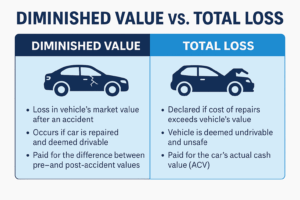
Diminished value refers to the loss in your car’s market value after it’s been repaired—even if the repairs were done perfectly.
Why? Because once a car’s been in an accident, its resale value drops. Period. Buyers see that accident on the CarFax, and dealerships offer you less—even if the car looks flawless.
A diminished value claim helps you recover that lost value. It’s not about the cost of repairs. It’s about the invisible financial damage that sticks with your car.
What Counts as a Total Loss?
A car is declared a total loss when the cost to repair it exceeds a certain percentage of its market value—usually around 70–75%, depending on your state or policy.
In simple terms: if it costs more to fix your car than what it’s worth, the insurer will likely cut you a check instead.
This is not the same as “it looks bad” or “I don’t want it anymore.” Total loss is a math equation. Cold. Calculated. Often frustrating.
You Can’t File Both—But You Need to Know Which One Applies
Here’s where many people get confused:
You cannot file a diminished value claim on a car that was declared a total loss.
If your car was totaled, you’re dealing with a payout and salvage titles—not post-repair market loss. But if your car was repaired and returned to you, that’s when diminished value becomes your next move.
Knowing the difference early can save you time, sanity, and money.
Why Diminished Value Can Be a Bigger Deal Than You Think
It’s easy to underestimate the impact—until you try to sell your car.
Let’s say your car was worth $25,000 before the crash. After repairs, it still drives perfectly. But now it’s worth $20,500 on the open market. That’s $4,500 gone, just because of one accident.
Most people never recover that loss. They didn’t know they could file. Or they got talked out of it by someone who benefits when they don’t file.
(We don’t let that happen. See how we help.)
Insurance Isn’t Going to Spell This Out for You
Spoiler alert: insurance adjusters don’t get bonuses for maximizing your claim.
If your car is not totaled, most insurers will quietly process the repair and move on—without telling you a diminished value claim even exists. They’re counting on your silence. They’re banking on confusion.
But knowledge changes the equation. So does documentation. So does backup.
When in Doubt, Ask: Was It Repaired or Replaced?
This one question can guide your next step:
“Did the insurance company repair my car and return it to me—or did they write it off and pay me out?”
- If it was repaired and someone else was at fault → You may be eligible for a diminished value claim.
- If it was totaled → You’re dealing with replacement value, not diminished value.
Simple question. Big impact.
Final Word: Don’t Let the System Decide What You’re Owed
You didn’t ask to be in an accident. But you can decide how you respond.
You can ask better questions. You can protect the true value of your vehicle.
Call (888) 438-8803 or visit to learn more about our diminished value and claims support. We’ve helped people just like you get what they’re owed—without doing it alone.
